Insights & Trends
The Best Playwright Alternatives and How to Pick One (as of May 2026)
Looking for Playwright alternatives? An honest 2026 guide to Cypress, Puppeteer, Selenium, low-code tools, and AI test engineers like Lark (and how to pick).
Playwright is a genuinely good tool. It's fast, it supports every major browser, the API is well-designed, and Microsoft keeps it well-maintained. If you searched for "Playwright alternatives," it probably isn't because Playwright is bad at what it does.
It's because what it does is no longer the whole job.
The cost of writing software has collapsed. Coding agents like Claude Code, Cursor, and Codex now produce features in minutes that used to take days. But every one of those features still has to be verified — and verification is exactly the part Playwright doesn't help with. You still have to sit down and hand-write the selectors, the waits, the assertions, the page objects. Then you have to maintain all of it as the product changes underneath you. The faster your team ships, the faster your test suite rots.
So the real question most people are asking isn't "what's a tool that's a little nicer than Playwright?" It's "what do I use for testing now that the rest of my stack got 10x faster?"
This post walks through the honest answer: where Playwright still wins, what the real alternatives are, and how to figure out which one fits your situation.
First — are you sure you want to leave Playwright?
A few signs you should probably stay:
You have a small, stable suite and a team that's comfortable writing and maintaining test code.
Your product changes slowly, so brittle selectors aren't a recurring tax.
Playwright is excellent at all of that. If that's you, the grass isn't greener.
The signs you've outgrown it look more like this:
Engineers spend more time fixing tests than the tests save.
Your suite breaks every time the UI gets refactored, even when nothing actually regressed.
You're generating features with AI agents and your test coverage can't keep pace.
Non-technical people on your team want to contribute tests but can't write code.
You're testing across more than just a browser — APIs, CLIs, SDKs, mobile, async jobs — and stitching together a different framework for each.
If that list hits closer to home, here are the alternatives worth knowing.
The alternatives, grouped honestly
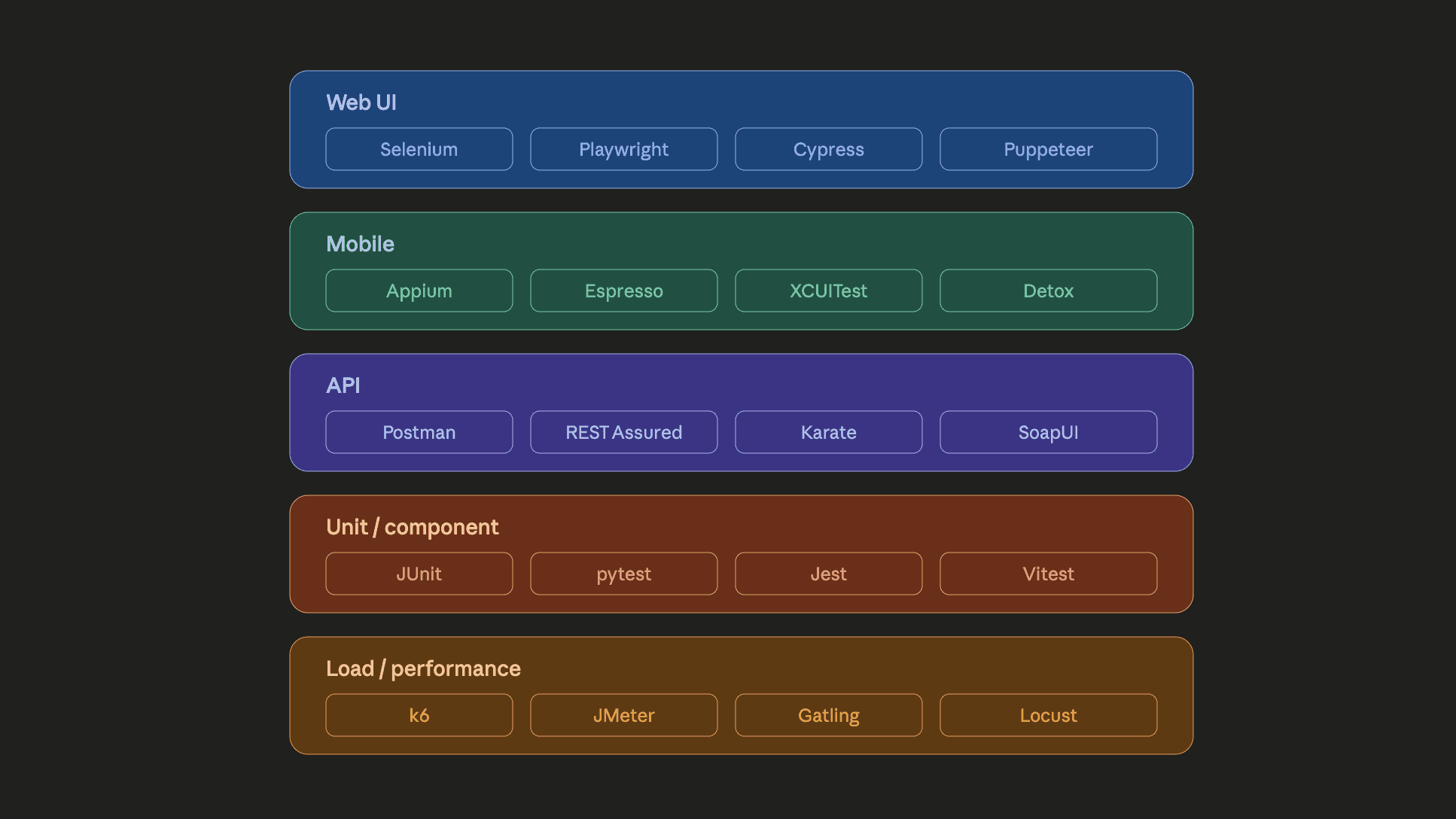
1. Other code-based frameworks (Cypress, Selenium, WebdriverIO)
These are the most obvious swaps, and the most overrated as "alternatives," because they don't change the underlying model. You're still writing and maintaining test code by hand.
Cypress has a great developer experience, an excellent test runner, and strong debugging. But it runs in-browser, which makes some cross-origin and multi-tab scenarios awkward, and it's still fundamentally selector-and-script maintenance.
Selenium is the granddaddy — maximum language and browser support, huge ecosystem, but the oldest and clunkiest API of the bunch.
WebdriverIO sits in between, with good flexibility and a decent plugin ecosystem.
The honest take: if your problem with Playwright is the brittleness and maintenance burden of hand-written tests, switching to another hand-written-test framework solves nothing. You're rearranging the same furniture.
2. Low-code / record-and-playback tools
Tools in this category let you click through your app and generate a test from the recording, often with some AI-assisted "self-healing" for selectors.
They lower the barrier to writing a test, which is real. But the recordings tend to be shallow, the self-healing is usually limited to swapping out selectors rather than understanding intent, and you often still hit a complexity ceiling where you're back to editing scripts by hand. They're frontend-oriented, so APIs and other surfaces remain someone else's problem.
Good fit if you want a lighter-weight UI testing tool and don't mind the ceiling. Less good if you want something that actually keeps up with a fast-moving product.
3. AI test engineers (Lark)
This is the newest category and the one that actually changes the model rather than the syntax. Instead of writing tests, you describe what should be true about your product in plain English, and an agent figures out how to verify it — then keeps the test working as your product changes.
Lark is the clearest example. A few things make it different from "Playwright but with an AI button":
You write in English, not code. A test is a name plus a plain-language description of what should happen. Lark's agents work out how to drive the app. Playwright tests are hard to write and maintain because they're code; Lark tests are trivial to write because they're natural language.
It maintains itself. When the product changes and a test would otherwise break, Lark distinguishes between a stale test (which it auto-repairs) and a real regression (which it alerts you to). That difference is the whole game — it's what stops the suite from rotting and keeps alert noise down.
It covers more than the browser. Web UI, APIs, CLIs, SDKs, mobile, and async workflows — from one platform. Playwright is frontend-only by design; Lark is built for products that are more than a frontend.
It fits the AI-coding loop. When a coding agent ships a PR, Lark can generate and run the test in the same PR and show you screenshots and video proving the feature works — before you merge. For non-technical builders who don't read code, those visual artifacts are the validation.
It runs continuously. Every PR, every deploy, on a schedule against staging or production, with alerts via Slack, email, or PagerDuty and auto-filed Linear issues on real regressions.
Worth being fair about the tradeoffs: it's a hosted product, not a local open-source library, so it's a different trust and pricing model than npm install playwright. And for deterministic regression tests Lark does still produce a script under the hood — the difference is that it owns maintaining it, not you. If you want maximum low-level control over every browser instruction, a code framework still gives you more knobs.
A quick way to decide
Ask yourself which sentence sounds most like your situation:
"I only have a few tests and I'm happy maintaining code." → Stay on Playwright. It's the best tool for that job.
"I'm fine writing tests but want a nicer DX than Playwright." → Cypress or WebdriverIO. Marginal improvement, same model.
"I want clicking-through-the-app simplicity for a frontend and can live with a ceiling." → A low-code record-and-playback tool.
"My team ships fast (often with AI agents), my tests keep breaking, and I'm testing more than just a browser." → An AI test engineer like Lark. This is the category built for the problem you actually have.
The bigger picture
The reason "Playwright alternatives" is a rising search isn't that a better selector-and-script framework appeared. It's that the shape of the work changed. When writing code was the expensive part, it made sense to spend human time hand-crafting tests. Now that agents write the features, hand-crafting and hand-maintaining the tests is the bottleneck — and the new tools worth looking at are the ones that automate that half, not just give you a cleaner way to do it yourself.
Playwright is still a great hammer. Just make sure you still have a nail.
Want to see what describing tests in plain English actually looks like on your own product? You can try it at getlark.ai.